
Pick The Odds Review
Reviews
Service Performance & Features
Key technical specifications and pricing details for Pick The Odds.
Pick The Odds is built as an “all-in-one” toolkit for odds shopping, +EV scanning, and arbitrage/middle finding, with a strong emphasis on customizable math (devigging, weighted “sharp book” formulas) and fast refresh rates.
It’s best used as a decision-support layer: it can surface potential edges, but outcomes still hinge on execution (price movement, stake limits, market rules, and variance).
- All lines are updated on average about 1.6 seconds. Some books are instant, some are polled. The polled are 1.6 seconds. Some sites are just slow though, like Betano, is just a slow site to load in general
- But other books are instant. DK, Espn, BetMGM, SportTrade, etc. You can see the list by going to their home page, scroll down to the sportbook coverage button about half way down there, each book is listed for which format it runs and its speed
- Games that are like 6 months out though, they update like once every 30 minutes.
Strengths of the Software
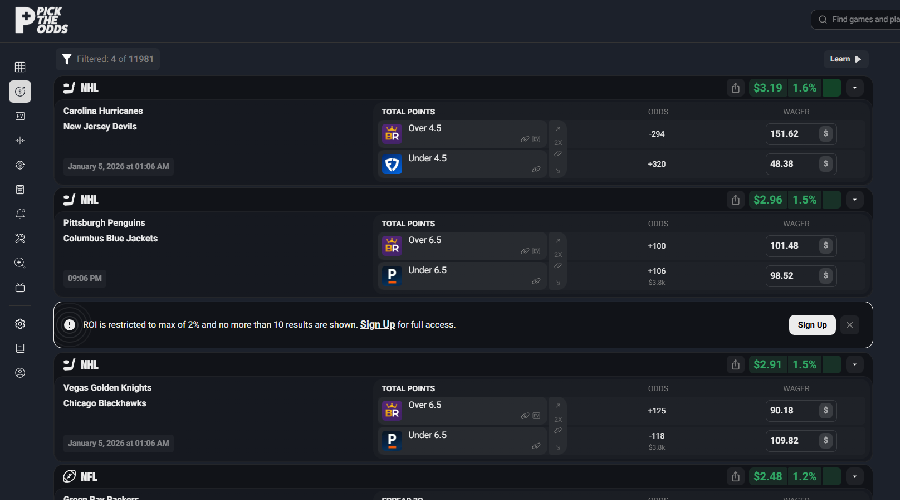
- Fast odds screen refresh and market context: The odds screen is marketed with updates “as fast as 1.6 seconds,” plus live game data and historical line graphs, useful when you’re trying to confirm whether a number is genuinely drifting or just flickering.
- Strong odds-shopping utilities: Best-odds, average, and hold columns (and the ability to order books how you want) make it practical for consistent line shopping instead of guesswork.
- Custom +EV formula building: You can build weighted formulas based on the books you consider “sharp,” which is important because +EV outputs are only as good as the reference price you trust.
- Full tool stack beyond +EV (arb/middles/low-hold/bonus conversion): It isn’t only an EV scanner, there are dedicated modules for arbitrage, middles, low-hold spotting, a free/bonus bet converter, notifications, and a general tool suite.
- Arbitrage workflow includes alerts and quick links: The arb module is designed around notifications and fast navigation to both sides—helpful in a strategy where delays are often the difference between a clean hedge and a missed one.
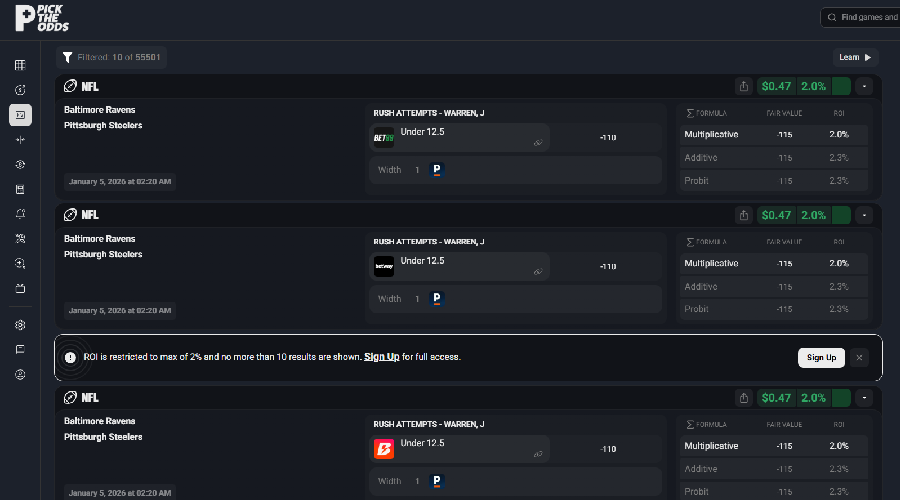
- Deep filtering and “process” controls: Tutorials highlight advanced control over what is displayed (columns, devig settings, minimum liquidity/wager constraints, rows), plus time-found indicators and multi-quick-link behavior, these small controls matter for reducing noise and misclick risk.
- Broad sportsbook ambition (including international and crypto-facing books): The platform scans over 100 sportsbooks, explicitly including international and crypto books, useful if your legal access is broader than just a handful of domestic operators.
- Low-friction trial of core UX: It’s promoted as usable for desktop and mobile, with parts of the odds screen available “no account needed,” which makes it easier to evaluate speed and usability before paying.
Weaknesses of the Software
- Execution realities can swamp the theoretical edge: +EV and arb flags don’t guarantee you’ll get the price, get the stake down, or avoid rule mismatches, especially when markets move quickly.
- Feature completeness looks mixed (bet tracking labeled BETA / “coming soon”): The bet tracking/dashboard area is presented as “coming soon” in parts, which suggests some workflow elements may still be maturing.
- US availability mismatch for some books: A third-party review specifically notes that not all covered books are recognized/usable in the US, which can reduce the practical value if your access is jurisdiction-limited.
- Plan details can be harder to validate from public pages: The site’s plan cards appear dynamically rendered in places, so it’s not always easy to audit exactly what each tier unlocks without going into the account panel.
Main target audience
Who it’s for
- Bettors who want to operate like “line shoppers with discipline,” not tip-chasers, people who compare prices across multiple sportsbooks and want tools for devigging, +EV filtering, and structured execution.
- Users with access to many sportsbooks (including international-facing ones) who benefit most from broad comparison and fast refresh.
How they can use it effectively
- Use +EV outputs as candidates, then verify: market type, rules, current odds, and staking discipline.
- Prefer prematch for cleaner execution; treat fast-moving/live markets as higher operational risk.
Betting site coverage
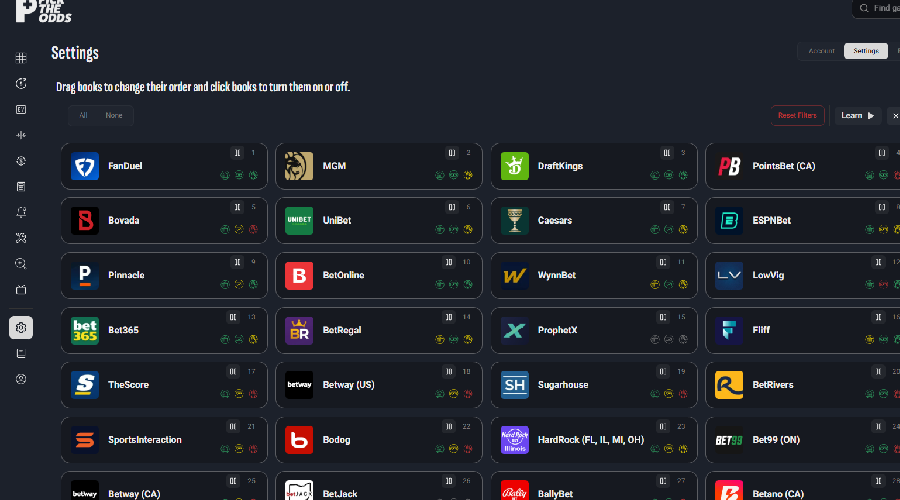
- Pick the Odds displays overpriced betting markets from 100+ sportsbooks, explicitly including international and crypto books.
- A published coverage graphic shows mainstream operators (e.g., FanDuel, DraftKings, BetMGM, Caesars) among the tracked books, implying it’s not solely offshore-focused.
Coverage is only “good” if it matches the books you can legally use and actually keep viable (limits are a real-world constraint for all edge-seeking approaches).
Pricing Plans
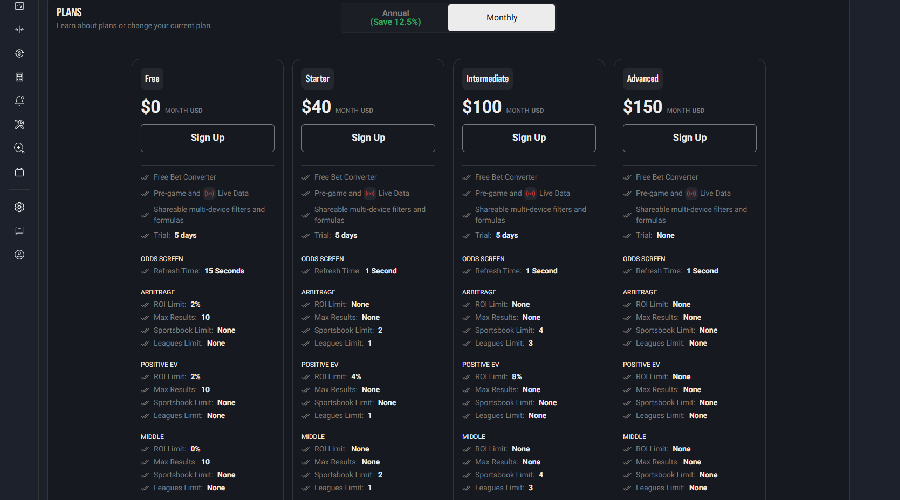
From the account management panel snippet, monthly tiers are shown as: Free ($0), Starter ($40), Intermediate ($100), Advanced ($150), with a 5-day trial shown for Free/Starter/Intermediate and no trial shown for Advanced.
The site also promotes an annual option with a stated 12.5% savings.
(Always validate the exact billable amount and what each tier unlocks at checkout/account level, because plan cards appear dynamically rendered in some places.)
Best alternative sites (what they’re better at, and why)
- OddsJam: Often stronger if you want a broad “regulated-market” toolkit (positive EV, arbitrage modules, promo conversion) with an ecosystem aimed at high-volume U.S./Canada-style execution.
- RebelBetting: Often better if you want a more systemized value-betting workflow with tracking/analysis emphasis and a longer-established “investment-like” process framing.
- BetBurger: Often better if your priority is classic arbitrage scanning volume and you’re operating in bookmaker environments where arb-first tools are the main need.
- OddsShopper’s arb tools: Better if you want a lightweight/free way to view some arb opportunities without committing to a full premium suite (you may give up depth, speed, and advanced controls).
- Prop-research tools (e.g., Outlier): Better if your main edge is player props research, trends, and decision support rather than multi-book EV/arbitrage scanning.