
Pinnacle Odds Dropper Review
Reviews
Service Performance & Features
Key technical specifications and pricing details for Pinnacle Odds Dropper.
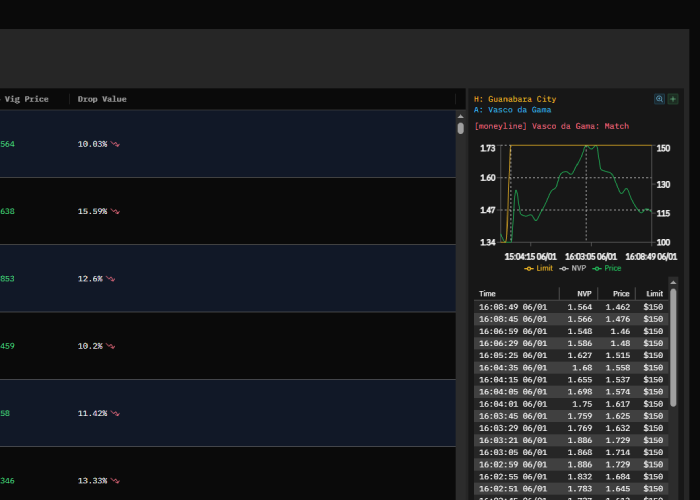
Pinnacle Odds Dropper (often shortened to POD) is a value-betting signal tool built around one idea: when Pinnacle’s price moves, it’s often because sharper information (or sharper money) has hit the market. POD monitors those movements, calculates a no-vig “price to beat” (NVP), then alerts you so you can check whether a slower sportsbook is still hanging a better number.
It’s not a “guaranteed profit” machine, execution (limits, line moves, bet acceptance, rules) decides whether the theoretical edge becomes real-world results.

Strengths of the Software
- Clear “price to beat” framework (NVP): POD’s NVP strips out Pinnacle’s vig and gives a concrete benchmark, if you can’t beat it, you’re not getting +EV by definition. That single reference point removes a lot of fuzzy decision-making.
- Signal quality anchored to a sharp market: Using Pinnacle as the “lead indicator” is sensible because the whole strategy depends on who moves first. POD is designed to alert quickly when Pinnacle’s odds shift.
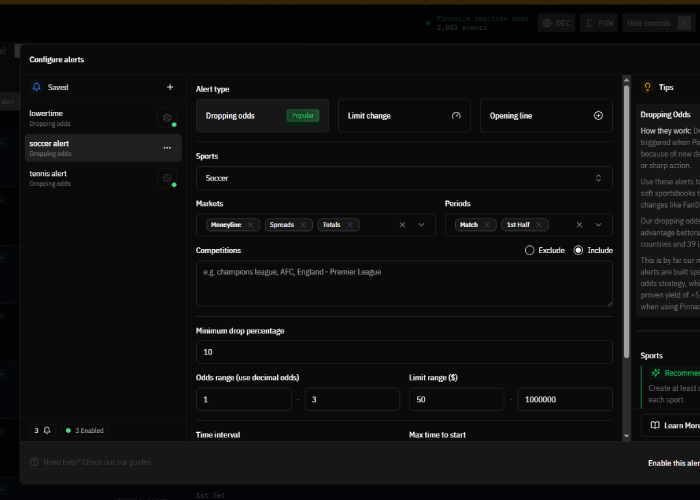
- Highly configurable alert system: You can shape alert output using filters (sport, market, competition, time-to-start, odds ranges, time interval, etc.). That matters because most raw alerts are noise until you tune them to your books and your tolerance for variance.
- Limit-change intelligence (rare but valuable): Limit Change alerts aren’t presented as “auto-bet triggers” (good), but as context—market efficiency rising, or uncertainty spikes, so you can decide where deeper research is worthwhile.
- Opening-line alerts for early-market opportunities: Opening lines are typically messier than mature markets. POD’s Opening Line alerts can help you spot soft-book mispricings early, while also being honest that beating Pinnacle’s opener with your own model is “hard mode.”
- Built-in bet tracking with CLV + automation: The bet tracker focus is a big plus for value betting because results are noisy in the short run. POD highlights CLV tracking and auto grading, plus exports for deeper analysis.
- De-vigging options beyond one method: POD supports multiple de-vig methods (Power/Additive/Multiplicative/Shin). That’s useful if you’re particular about how fair odds are estimated (even though most users can stick to a default).
- “Sportsbook agnostic” in the way that actually matters: Because it’s benchmark-driven, you can apply it to almost any sportsbook you can access, you’re not limited to a fixed list inside the tool.
Weaknesses of the Software
- Learning curve (and “most alerts won’t be bets” is real): POD itself acknowledges that beginners will see many dud alerts, and that filtering + experience is the skill. If you want “ready-made picks,” this workflow can feel heavy at first.
- You still have to do the cross-book execution work: POD gives the signal and the benchmark; you still need to verify the other sportsbook’s odds, confirm market matching, and get down quickly. That makes it less “hands-off” than multi-book scanners that surface both sides directly.
- Single-source dependency risk: If your entire edge is “follow Pinnacle moves,” you’re exposed to situations where the move doesn’t reflect what you think it reflects (timing quirks, bounce-backs, market microstructure). POD provides tools to manage this, but it’s a structural limitation of the strategy.
- Soft-book limitations remain a bottleneck: Even if the method is solid, many recreational-facing books limit sharp action. POD can help you find value “anywhere,” but it can’t prevent account restrictions.
Main target audience (Who are they, how can they use the service)
Who it’s for
- Bettors focused on long-run expected value, comfortable treating betting like a process (tracking, filtering, iteration) rather than chasing short-run results.
- People who have access to multiple sportsbooks and want a systematic way to identify when a slow book is lagging behind a sharper benchmark.
- Traders/serious bettors who care about CLV as validation that they’re beating the market, not just running hot.
How they can use it
- Use alerts as candidates, then only bet when you can beat the NVP by a margin you’re comfortable with (your “margin of safety”).
- Focus on sports/competitions where your target books are slowest, and refine filters until the signal-to-noise fits your time and bankroll.
Betting site coverage
POD’s “coverage” is less about listing bookmakers and more about which Pinnacle markets it can monitor, because that’s the signal engine.
- Markets supported: Moneyline, totals, and spreads are explicitly referenced in the plan feature set; the tool also highlights pre-match and in-play odds support at higher tiers.
- Sports breadth: Getting-started configs are provided across common high-liquidity sports (e.g., soccer, basketball, tennis, baseball, hockey, etc.).
- “Use with any sportsbook”: The workflow is to benchmark against Pinnacle and then shop your available books, so practical coverage depends on what you can legally access and how quickly those books move.
Pricing Plans
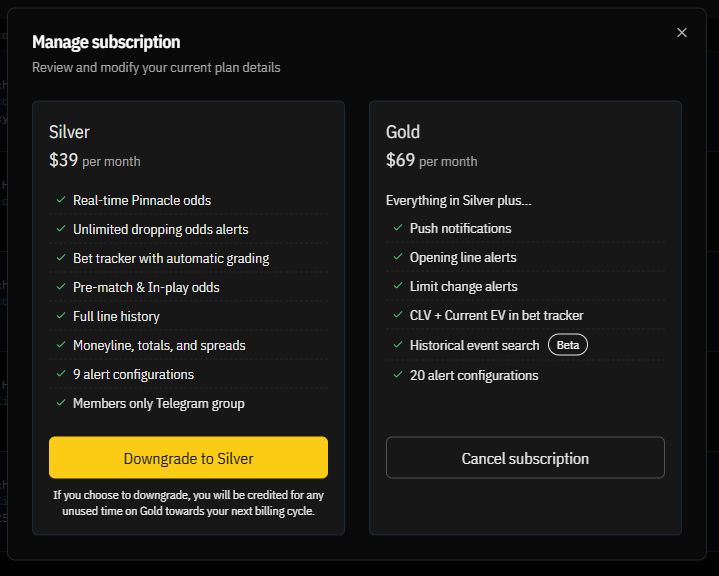
POD is structured into three tiers with a 21-day money-back guarantee.
- Bronze — $39/month: Built around core dropping-odds alerts, real-time Pinnacle odds, bet tracking/auto grading, line history, and basic markets.
- Silver — $75/month: Adds significantly more alert configurations plus event search and pre-match & in-play odds access.
- Gold — $99/month: Adds more configurations plus push notifications, Opening Line alerts, Limit Change alerts, and expanded tracking metrics like CLV/current EV.
Best alternative sites (what they’re better at, and why)
- RebelBetting: Better fit if you want a more traditional “value bet feed” built from multi-book comparisons rather than a Pinnacle-move-driven workflow.
- BetBurger: Better if your primary goal is arbitrage volume with broad bookmaker coverage and you want an arb-first interface.
- OddsJam: Better for a “toolbox” approach (especially in regulated markets): odds screens, EV scanning, promo/free-bet workflows, and broader operational tooling.
- Pick The Odds: Better if you want very fast multi-book odds screens and custom “sharp book weighting” formulas, with a bigger emphasis on shopping many books at once.
- BetWasp: Better if you prefer a straightforward +EV finder + odds comparison workflow that isn’t tied as tightly to one sharp source.